Posted by Alpha Packaging on | Comments Off on How PCR Packaging Reduces Plastic Waste and Your Carbon Footprint
Click to Expand
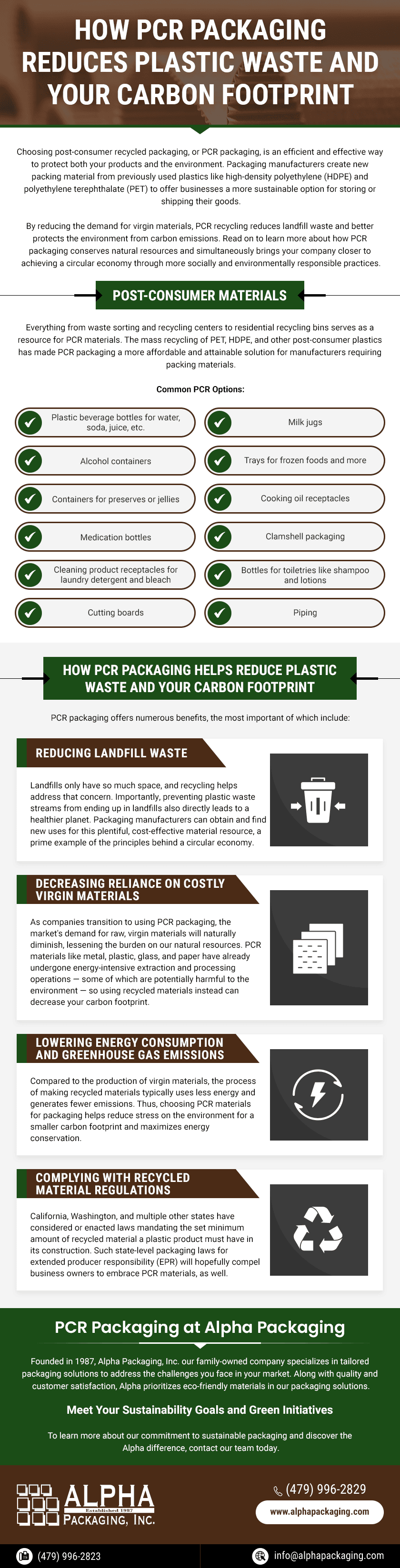
Choosing post-consumer recycled packaging, or PCR packaging, is an efficient and effective way to protect both your products and the environment. Packaging manufacturers create new packing material from previously used plastics like high-density polyethylene (HDPE) and polyethylene terephthalate (PET) to offer businesses a more sustainable option for storing or shipping their goods.
By reducing the demand for virgin materials, PCR recycling reduces landfill waste and better protects the environment from carbon emissions. Read on to learn more about how PCR packaging conserves natural resources and simultaneously brings your company closer to achieving a circular economy through more socially and environmentally responsible practices.
Post-Consumer Materials
Everything from waste sorting and recycling centers to residential recycling bins serves as a resource for PCR materials. The mass recycling of PET, HDPE, and other post-consumer plastics has made PCR packaging a more affordable and attainable solution for manufacturers requiring packing materials. Common PCR options include:
Plastic beverage bottles for water, soda, juice, etc.
Cleaning product receptacles for laundry detergent and bleach
Bottles for toiletries like shampoo and lotions
Cutting boards
Piping
By sending pre-used plastics to factories instead of landfills as part of smarter waste management, recycling enhances sustainability and keeps a significant amount of plastic out of the environment and reduces your brand’s carbon footprint.
Explore Our Full Range of Packaging Products
PCR packaging offers numerous benefits, the most important of which include:
Reducing landfill waste. Landfills only have so much space, and recycling helps address that concern. Importantly, preventing plastic waste streams from ending up in landfills also directly leads to a healthier planet. Packaging manufacturers can obtain and find new uses for this plentiful, cost-effective material resource, a prime example of the principles behind a circular economy.
Decreasing reliance on costly virgin materials. As companies transition to using PCR packaging, the market’s demand for raw, virgin materials will naturally diminish, lessening the burden on our natural resources. PCR materials like metal, plastic, glass, and paper have already undergone energy-intensive extraction and processing operations — some of which are potentially harmful to the environment — so using recycled materials instead can decrease your carbon footprint.
Lowering energy consumption and greenhouse gas emissions. Compared to the production of virgin materials, the process of making recycled materials typically uses less energy and generates fewer emissions. Thus, choosing PCR materials for packaging helps reduce stress on the environment for a smaller carbon footprint and maximized energy conservation.
Complying with recycled material regulations. California, Washington, and multiple other individual states have considered or enacted laws mandating the set minimum amount of recycled material a plastic product must have in its construction. Such state-level packaging laws for extended producer responsibility (EPR) will hopefully compel business owners to embrace PCR materials, as well.
PCR Packaging at Alpha Packaging
PCR packaging offers businesses a more eco-conscious alternative to conventional packaging materials. Founded in 1987, Alpha Packaging, Inc. strives to be your one-stop shop for sustainable, customized packaging systems. Our 200,000-square-foot facility in Greenwood, Arkansas, is equipped with advanced packaging machinery that enables us to produce virtually any type of box or container for your storage or shipping needs.
We understand how the quality of your packaging ultimately contributes to positive customer engagement with your brand. From corrugated boxes to 3M® packaging tapes, our family-owned company specializes in tailored packaging solutions to address the challenges you face in your market. Our diverse client base covers sectors ranging from automotive and heavy equipment to retail and food/beverage.
Along with quality and customer satisfaction, Alpha prioritizes eco-friendly materials in our packaging solutions. With PCR packaging, we can assist you in meeting your company’s sustainability goals and green initiatives with high-quality packaging you can trust with your products. To learn more about our commitment to sustainable packaging and discover the Alpha difference, contact our team today.
Posted by Alpha Packaging on | Comments Off on Types of Eco-Friendly Packaging
Consumer demand for sustainable manufacturing practices and products continues to grow. Companies in turn seize the opportunity to reduce their carbon footprint and impact on the environment, and food and beverage products are no exception. Steps you take toward sustainability may also give you a boost with eco-friendly branding and messaging.
Packaging is one of the most visible ways you communicate with your customers and entice new ones. If you’re just starting to adopt sustainable packaging or looking for new and improved options, Alpha Packaging can help. In this article, we’ll explore the definition of sustainable packaging and look at several examples for food and beverage producers.
About Sustainable Food Packaging
It’s easy to claim you use sustainable food packaging, but what does that really mean? While the goal is always to choose packaging that has the smallest impact on the environment, not all options are sustainable to the same degree. The best ones address several of these aspects of sustainability:
Packaging materials are recycled or have high post-consumer use content
New packaging materials made from renewable sources (i.e., plant fibers or resins)
Designs that reduce the overall amount of packaging material
Packaging production processes that minimize resource consumption (i.e., water, electricity)
Packaging that can be recycled, composted, or reused
Materials that do not pollute waterways or harm wildlife as they break down
Benefits Of Sustainable Food Packaging
Food and beverage manufacturers gain many benefits by investing in sustainable food packaging, such as:
Using sustainable packaging can reduce your brand’s overall carbon footprint and environmental impact.
Sustainable and compostable packaging has a premium appeal that enhances your brand’s image and appeals to consumers.
When eco-conscious consumers trust your commitment to the environment, they are more likely to buy and endorse your products.
Eco-friendly packaging is often lighter and more efficient to pack, saving you money on shipping.
Types Of Sustainable Food Packaging
A sustainable package is only a viable option if it is comparable to traditional packaging in terms of protecting contents from damage, keeping products fresh, and sealing against leaks and contamination. Fortunately, today’s sustainable food packaging selections stand up to this challenge.
Glass Packaging
Glass packaging is a trusted, durable material and is 100% recyclable. This means you can package your products in recycled glass containers, and then those containers can be recycled when they’re empty. This cycle can continue indefinitely.
Kraft Paper Packaging
Kraft paper packaging includes Kraft Paper for Void Fill, Grocery Bags, and Food Delivery Bags. It is a lightweight and versatile choice for filling in empty spaces in boxes, layering, and wrapping. Kraft paper is made from 100% recycled wood pulp, and can be recycled after use.
Plant-Based Packaging
Plant-based packaging includes Eco-friendly Loose Fill, Foam Wrap, and Cushioning Pads. These are made with renewable materials derived from plant starches and other organic vegetal matter.
Compostable & Biodegradable Packaging
Compostable and biodegradable packaging includes Corrugated Trash Cans, Biodegradable Ice Packs, and Honeycomb Sheets. Compostable foam wrap is a plant-based, protective packaging that can be used in multiple applications. It is typically composed of starches from plant-based sources and organic natural fibers. Using compostable packaging reduces your reliance on petroleum-based sources.
Metal Packaging
Reusable tins and boxes made from food-grade metal are strong and attractive options that many consumers gravitate toward (often because they plan to repurpose the container). Metal packaging can also include Food-grade Aluminum Foil. When properly cleaned, aluminum foil can be recycled. Metals, like aluminum, steel, and tin, can be almost infinitely recycled without compromising properties or quality. This reduces the need to extract and process virgin metals.
Recyclable Packaging
Recyclable packaging includes Tape, Void Fill, Insulated Containers, Thermo Chill® Cooler Boxes, and Paper Bubbles. Alpha Packaging manufactures custom recyclable packaging solutions, including plastic corrugated products, triple-wall boxes, and wholesale pizza boxes. Our kraft pizza boxes are a popular choice for packaging freshly made pizzas in a safe and earth-friendly packaging option.
Sustainable Food Packaging Solutions by Alpha Packaging
Alpha Packaging is committed to supplying packaging made with eco-friendly materials and manufacturing processes. We also offer a full line of plastic and corrugated boxes, inserts, and mailers along with custom services for packaging, foam, and printing.
Whether you have a package design in mind or want to explore options, Alpha Packaging can help. Request a quote to speak with us about your sustainable food packaging needs.
Posted by Alpha Packaging on | Comments Off on How to Recycle Corrugated Packaging
How to Recycle Corrugated Packaging
With many industries striving to go green and reduce their carbon footprint, corrugated packaging has become a popular choice. This type of packaging is tough and sturdy which makes it great for shipping and packaging. Additionally, it is made from a combination of wood fibers and paper pulp, making it recyclable up to seven times. Recycling corrugated packaging reduces waste, conserves resources, and protects the environment.
Why is Corrugated Sustainable?
The concept of sustainability is based on the idea that our existence depends on our natural environment and that it’s important to maintain conditions that allow us to coexist with nature in the present and future.
Corrugated packaging is a sustainable option because it’s made primarily from trees, which are a renewable resource. According to Corrugated, this packaging has a high recovery rate of around 90%. In 2018, the corrugated industry was able to recover and recycle 96% of the old corrugated containers. Compared to other packaging materials, corrugated materials have an extremely high recovery rate, while plastic has a recovery rate of only about 15%.
Moreover, corrugated packaging is biodegradable and can be recycled multiple times without losing strength or quality. This makes it a much better option compared to other non-biodegradable packaging materials that can take hundreds of years to decompose in landfills and often release harmful chemicals into the environment.
How to Recycle Corrugated Cardboard
Most corrugated cardboard boxes are recyclable, with only a few exceptions. These boxes are commonly made from recycled materials, such as other corrugated boxes, which makes them one of the most environmentally friendly packaging materials available. The recycling process for corrugated cardboard is as follows:
Preparation: Remove additional packaging materials such as foam inserts, plastic wraps, or wood inserts to ensure that the recycling process only involves the corrugated box.
Cutting: Use a box cutter to cut the packing tape on the bottom and sides of the box to loosen it and make it easier to break down.
Flattening: Extend all of the box’s flaps and press it flat. This step saves space during transportation and makes storing the boxes easier until they are recycled.
Sorting: Check with your local recycling program to determine if corrugated boxes need to be separated from bottles and cans. If so, separate them accordingly.
Recycling: Place the broken-down corrugated box in the curbside recycling bin or take it to a recycling center and place it in the correct bin.
Baling (optional): Many recycling facilities use a baler machine to compact the boxes into dense bundles. This saves space, reduces the number of trips needed for transportation, and promotes more efficient use of resources.
Repulping: The bales are transported to a paper mill where the corrugated boxes are fed into a repulper and agitated to create a slushy mixture of fiber and water.
Contaminant Removal: The fiber solution is filtered to eliminate contaminants and poured onto a conveyor belt to create a seamless mat of fibers.
Slitting and Winding: The wet fiber is dried, rolled onto a large reel spool, slit, and rewound into individual rolls. These rolls are then shipped to sheet plants to be utilized as eco-friendly corrugated packaging.
Alpha Packaging’s Sustainability Efforts
At Alpha Packaging, we are committed to sustainability and environmentally friendly practices. We recognize that corrugated cardboard is a greener alternative to plastic, which is why we use clean processing methods, to take our sustainability initiatives to the next level. Additionally, we prioritize the use of eco-friendly materials in our facility.
We create corrugated containers that are made to be as environmentally conscious as possible, reducing waste, chemical impact, and the use of harmful plastics. Our boxes are biodegradable, which helps our customers and their end-users reduce their carbon footprint. We integrate green principles into our product development to ensure we are in line with the latest sustainability practices.
We believe that our sustainability efforts will continue to expand as we integrate more green practices into our operation, helping preserve the Earth’s resources for future generations and keeping local communities cleaner.
Go Green with Alpha Packaging
When you choose products with eco-friendly packaging, you are helping to reduce the amount of waste that ends up in landfills and oceans. Request a quote or contact us today to learn more about our sustainable packaging solutions, and let us work together to create a greener future.